
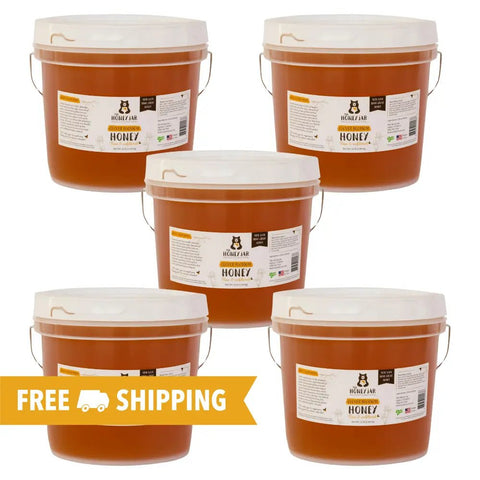
Bulk & Wholesale Raw Honey

Free Shipping on Bulk Pure Raw & Unfiltered Honey in Pails or Jugs

Real raw, unfiltered honey by the gallon, from a family that's been doing this for 21 years. It's strained, never filtered, and never heated over 118°F, so it reaches you the way honey should. Choose an airtight pail or a pourable jug, get free shipping anywhere in the US, and pay one of the best prices per ounce you'll find on honey this real.

Stocking your kitchen, your café, or your shop? Start with our bestselling clover. It's mild, smooth, and the easy favorite for almost everyone.

Changing filter and sort options updates the products shown.

Filter:

Honey Varietal
0 selected Reset

6 products

Rating: 4.9 out of 5
Clover Honey - Raw and Unfiltered Bulk - 1 gallon (12lbs)
Regular price $74.99 Sale price$79.99 Unit price$0.39 / oz
Save $5.00 Bestseller
Rating: 4.7 out of 5
Utah Wildflower Honey - Raw and Unfiltered Bulk - 1 gallon (12lbs)
Regular price $74.99 Sale price$79.99 Unit price$0.39 / oz
Save $5.00
Rating: 4.6 out of 5
Orange Blossom Honey - Raw and Unfiltered Bulk - 1 gallon (12lbs)
Regular price $84.99 Unit price$0.44 / oz
Rating: 4.9 out of 5
Clover Honey - Raw and Unfiltered Bulk - 5 gallon (60lbs) - Bucket or Jug
Regular price $314.99 Sale price$349.95 Unit price$0.33 / oz
Save $34.96
No reviews
1 Gallon (4 quarts) Clover Blossom Honey - Glass Jars
Regular price $102.92 Sale price$115.96
Save $13.04

The value of buying by the bucket

The bigger the size, the less you pay per ounce

You're getting real raw honey, strained not filtered with the pollen left in, for less per ounce than a small plastic bear of the processed stuff costs at the store. Buy the size that fits how you use it. The bigger sizes simply cost less per ounce.

SizePricePer ounce
1 gallon (12 lbs)$74.99about $0.39
5 gallon (60 lbs) · best value$314.99about $0.33
Typical grocery-shelf honeyusually $0.60+

Grocery figures are typical, shown for comparison. Our per-ounce prices are exact.

Not sure which size?

How long does a gallon last?

A gallon is 12 pounds of honey. For a family that sweetens tea, bakes, and spreads it on toast through the week, a gallon tends to last most households several months to a year. Going through more than that, or buying for a business? The 5 gallon is the best value per ounce.

Want to taste it before you commit to a whole gallon? Start with a quart of the same raw clover honey.

Ordering for a business?

Wholesale honey pricing, no account required

Cafés, bakeries, farm stands, and shops buy their bulk honey here. The price you see is the price everyone pays, our wholesale price, right on the page. No account to open, no minimum, no waiting on a quote. Order the gallon or the 5 gallon, reorder in a couple of clicks when you run low, and email us anytime for a receipt or a standing order.

What to expect from real raw honey

Real honey isn't uniform, and that's the point

We strain our honey instead of filtering it, so the pollen stays in. Color and flavor shift a little from season to season and hive to hive. A darker, bolder batch or a lighter, milder one is normal. Honey that looks perfectly uniform has usually been processed heavily to look that way. It will also crystallize over time, which is a sign it's real, not a sign it's gone bad. There's more on that in the questions below.

If something isn't right, please let us know so we can fix it. If you love it tell everyone who will listen! Every order is backed by our satisfaction guarantee.

Bulk honey questions

Bulk honey, answered

Is your honey really raw and unfiltered?

Yes, and we hold ourselves to a published standard: never heated above 118°F, strained at 400 microns so the natural pollen stays in, and never pasteurized.

Most grocery-store honey is cooked at 140–160°F and filtered crystal-clear — done to look appealing on a shelf and to delay crystallization. We do neither. Read our published raw & unfiltered standard.

Do you offer free shipping?

Yes — free shipping on orders over $35, to all U.S. states including Alaska and Hawaii, as well as U.S. territories and APO/FPO addresses. Wholesale orders are excluded. See our shipping policy.

Every order also includes free Package Protection, so if your honey arrives damaged or goes missing, we make it right.

Should I choose the gallon pail or the gallon jug?

Both hold the same 12 pounds of honey. Choose based on how you plan to use it:

  • Gallon jug — easier to pour. The better pick for everyday kitchen use.
  • Gallon pail — airtight and food-grade, with a wide opening. The better pick for long-term storage, refilling smaller jars, or scooping honey once it has crystallized.

For long-term storage in either container, we recommend transferring the honey to glass jars.

How much does a gallon of honey weigh?

A gallon of honey weighs about 12 pounds (5.44 kg). Honey is roughly 40% denser than water, which is why a gallon of honey weighs so much more than the 8.3 pounds a gallon of water weighs.

We sell honey by weight rather than volume. Every container is weighed to make certain you receive at least what you paid for — and usually a little more.

Is the bulk container BPA-free?

Yes. Our gallon pails and jugs are food-grade and BPA-free. They seal airtight to preserve flavor and quality, and they're far lighter than glass — which is what lets us keep bulk shipping affordable.

Do you offer larger sizes or wholesale pricing?

Yes. Beyond the 1-gallon, we carry larger bulk sizes including 5-gallon pails. Browse all bulk honey sizes.

For wholesale volumes or a custom quote, get in touch with us — we're a small family operation and we'd rather talk it through with you.

Can I use bulk honey for baking, brewing, or making mead?

Yes — a good share of our bulk customers do exactly that. Homebrewers typically use somewhere around 2–3 pounds of honey per gallon of finished mead, so a 12-pound pail comfortably covers a standard 5-gallon batch.

It's also a practical size for bakers, coffee shops, and anyone refilling smaller jars at home. Because it's raw and unfiltered, you get the full character of the varietal rather than the flat sweetness of heavily processed honey.

Why did my honey crystallize, and is it still good?

Yes, it's still perfectly good. Crystallization is simply what real, raw honey does over time. It's evidence your honey wasn't pasteurized or heavily filtered — not a sign that anything is wrong with it.

Ours tends to crystallize with a smooth, creamy consistency. That's naturally crystallized honey — it is not whipped or creamed honey.

To return it to a liquid state, set the sealed container in a bath of warm (not boiling) water and stir occasionally as it softens. Skip the microwave and avoid high heat: overheating destroys the very qualities that make raw honey worth buying in the first place.

How should I store my honey?

Keep it sealed, at room temperature, out of direct sunlight. Honey is shelf-stable and needs no refrigeration — in fact, cold speeds up crystallization.

If you're storing a large container for a long stretch, we recommend transferring the honey into glass jars. For honey you'll work through within a few months, the original container is fine as-is.

Does raw honey expire?

No. Honey is one of the very few foods that does not spoil. Its low moisture and natural acidity make it inhospitable to the microbes that spoil other foods.

Over time it may crystallize or darken slightly. Neither affects safety, and neither means the honey has gone bad.

Is your honey certified kosher?

Yes. Our honey is certified kosher by OK Kosher. View our kosher certificate.

Can babies eat raw honey?

No — do not give honey of any kind to infants under 12 months old. This applies to raw honey and pasteurized honey alike, and to every brand, not just ours.

Honey can contain Clostridium botulinum spores. An adult digestive system handles them without trouble, but an infant's cannot, and they can cause infant botulism. Honey is considered safe for children over one year of age and for adults. This guidance comes from the CDC and the American Academy of Pediatrics.

Still have a question? Get in touch.